IKEA: The World's Premier Scandinavian Interior-Design Retailer
- Jonny Cook
- Nov 14, 2018
- 3 min read
Updated: Nov 28, 2018
IKEA's story begins in 1926.

The now-multinational, premier name in Scandinavian interior design started with Ingvar Kamprad's entrepreneurial aspirations while growing up on a farm called "Elmtaryd," near the village of "Agunnaryd" in Southern Sweden. It was here that Kamprad learned to appreciate the value in making the most out of everything he had, despite growing up in relative poverty. IKEA would develop after this model, and is known today for its minimalist and affordable furniture tailored to the masses.
The Early Stages
When he was 17, Kamprad received some money from his father as a reward for his good grades in school. He would use this money to establish his own business, IKEA, an acronym composed of his initials, "I.K.", and the farm and nearby village making up the "EA."He began by just selling pens, wallets, tobacco pipes, and other product needs, but at a reduced cost from competitors.
His small business soon grew into a mail-order service, which he ran through the local milk van to deliver products to a nearby train station. The popularity of this service and his use of advertisements in local newspapers caused word to spread, and by 1948, Kamprad began producing furniture of his own. Despite increasing competition in this industry, IKEA's first big break came in 1953, when Kamprad opened a furniture showroom in Älmhult, Sweden where customers could view and test his furniture before ordering it, which launched IKEA ahead.
In a serendipitous event, one of IKEA's first workers removed the legs from a LÖVET table to fit it into a car while avoiding damage in 1957. With this discovery, IKEA began utilizing "flat packs" and so grew their sale of "self-assembly" items, which allowed the company to keep shipping costs down, increasing profitability of sales. By 1958, the first IKEA store opened in Sweden, a mere 6700 sq. meters in size. Although shrinking in comparison with the size of IKEA's stores today, this was the largest furniture display store in Scandinavia to this point.
Growth of the brand
Running in conjunction with their focus on interior design, IKEA opened a restaurant in their store in Älmhult which would be a trademark of the company which remains today.
In the 1960s, IKEA began producing their tables more affordably through the use of particle board––a material made from wood chips. During this time, they used neutral colors in their design, as demonstrated in the catalogue below.

By 1965, IKEA's popularity had spread across Scandinavia, and Kamprad was able to open their largest store yet, 31,000 sq. meters in Stockholm, with a circular design inspired by the New York Guggenheim Museum. This size and design of the store would come to resemble the design of IKEA stores which they still retain.
The late '60s and early '70s saw IKEA adapting with the times, as they explored brighter colors and more varied patterns, demonstrating the company's willingness to challenge the status-quo. This adaptiveness is shown with the two catalogues below.


The latter part of that decade saw two major breakthroughs for the IKEA brand. Their release of the Billy bookshelf in 1978 and the Klippan sofa in 1980 proved massively successful, and went on to become IKEA's two highest selling items ever.
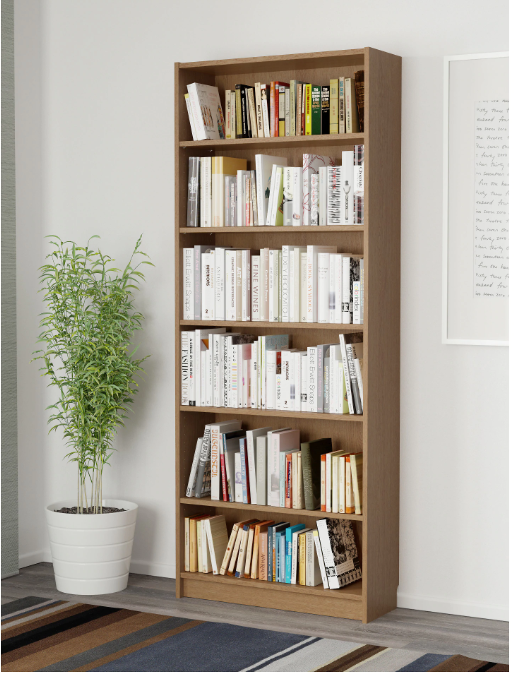

As with many '80s brands, IKEA began using more colorful patterns in their designs. With the turn of the '90s, however, IKEA shifted back to using more neutral colors in their designs. Another notable change for the retail giant came in 1990, when they proposed their first environmental policy to ensure the company took responsibility for the activities conducted under the IKEA name. As a result, IKEA began using more glass and wood in their products, and fewer unsustainable materials, like plastic.
The '90s also market a shift in IKEA's marketing to include children's furniture. Their addition of the furniture series "MAMMUT" made their product appeal even greater, while providing a safe alternative for parents to buy for their children, since these products used rounded corners and were built with resilient, tough materials.

In recent years, IKEA has largely prioritized its efforts towards creating furniture that could serve multiple purposes, is easy to assemble, and could fit in various places in the home. Although Kamprad passed in January of this year, he lived to see his teenage aspirations grow into the largest retailer of Scandinavian interior design in the world, with stores in 40 countries and territories across the world.


Comments